%201.svg)



Board-Certified ENTs Explained: Why It Matters More Than Online Ratings
Searching for an ENT often begins the same way: you type a few words into Google, compare star ratings, read a handful of reviews, and hope you've found the right doctor. Reviews can certainly offer helpful insight into a patient's experience, but they don't tell the whole story. A five-star rating can't explain the physician's training, how they approach difficult diagnoses, or whether they have the background to evaluate complex sinus and allergy conditions. At Dallas Breathe Free Sinus & Allergy Centers, we believe patients deserve to understand what board certification actually means and why it's one of the most important factors to consider when choosing an ear, nose, and throat physician.
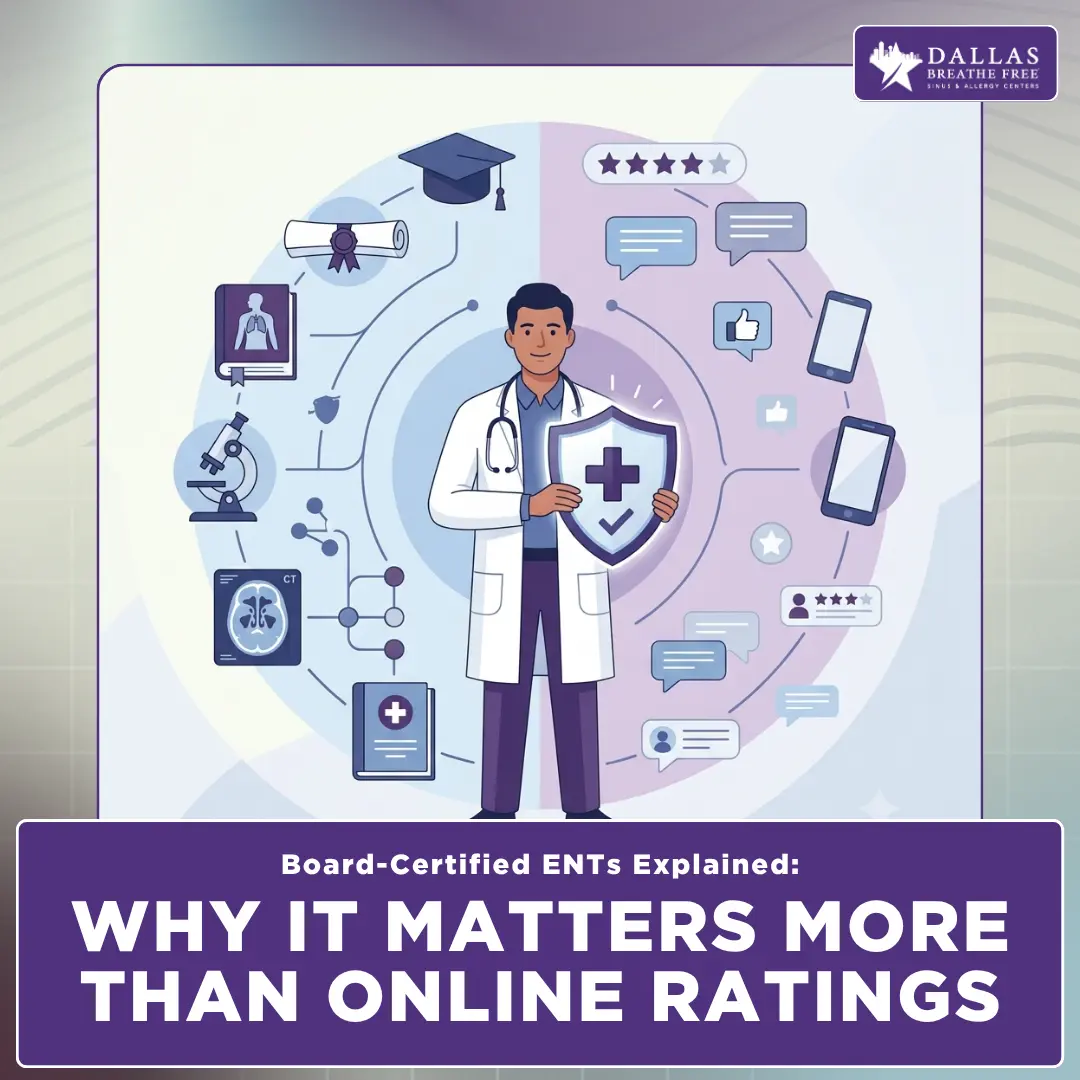
What Does "Board-Certified" Mean?
Board certification is more than a credential displayed on a website.
Before becoming board-certified in otolaryngology, a physician must complete four years of medical school followed by years of intensive residency training focused on conditions affecting the ears, nose, throat, head, and neck. After residency, they must successfully complete rigorous examinations that evaluate both medical knowledge and clinical decision-making.
Maintaining board certification also requires ongoing education and continued participation in professional standards as the field evolves.
For patients, board certification indicates that an ENT has completed nationally recognized specialty training and certification requirements and participates in ongoing professional development.
Online Reviews Tell You About Experiences—Not Qualifications
Patient reviews are valuable because they offer insight into communication, office efficiency, and overall satisfaction.
They may tell you whether patients felt listened to, whether appointments ran on time, or whether staff members were helpful.
What reviews can't tell you is:
- How thoroughly your condition will be evaluated.
- Whether multiple causes of your symptoms will be considered.
- What training the physician has completed.
- Whether the provider has experience managing complex ENT conditions.
A physician with fewer online reviews may have years of experience diagnosing conditions that aren't immediately obvious, while a highly rated practice may simply have a larger online presence.
Reviews matter—but they should be one piece of a much larger decision.
Why Experience Matters with Sinus and Allergy Conditions
Many ENT symptoms overlap.
Congestion, facial pressure, headaches, postnasal drip, and a reduced sense of smell can all be caused by allergies, chronic sinusitis, nasal polyps, a deviated septum, or several conditions occurring together.
Determining the true cause often requires more than treating the most obvious symptom.
A board-certified ENT is trained to evaluate the entire upper airway, considering how anatomy, inflammation, environmental factors, and medical history may all be contributing to persistent problems.
That broader perspective may help guide further evaluation and treatment recommendations, particularly when symptoms continue despite previous treatment.
Dallas Patients Face Unique Environmental Challenges
North Texas has one of the country's longest and most recognizable allergy seasons.
Mountain cedar, oak, elm, grasses, ragweed, and mold all become active during different times of the year. Because these allergens overlap, many Dallas-area residents experience recurring congestion across multiple seasons rather than during one short allergy period.
It's easy to assume every episode of nasal congestion is simply another round of seasonal allergies. However, repeated inflammation may also reveal chronic sinus disease, structural concerns inside the nose, or other ENT conditions that deserve a closer evaluation.
Choosing a physician who understands these overlapping factors is particularly important in a region where environmental triggers are present for much of the year.
What Else Should You Look for in an ENT?
Board certification is an excellent starting point, but it's not the only factor worth considering.
When choosing an ENT in Dallas, consider a practice that:
- Takes time to understand your medical history.
- Explains diagnoses in language that's easy to understand.
- Uses diagnostic tools when appropriate, including allergy testing or nasal endoscopy.
- Develops treatment recommendations based on your individual symptoms rather than a one-size-fits-all approach.
- Encourages questions and involves you in decisions about your care.
These qualities often reflect a patient-centered approach that extends beyond credentials alone.
How Do I Know It's Time to Stop Waiting and Get Checked?
If you've been relying on internet searches or treating recurring symptoms on your own, an evaluation may be worthwhile if:
- Congestion lasts for several weeks.
- You experience recurring sinus infections.
- Facial pressure has become a regular problem.
- Nasal blockage affects your sleep.
- Symptoms continue despite previous treatment.
- You're unsure whether allergies or another ENT condition is responsible.
An evaluation doesn't necessarily lead to a procedure. More often, it helps identify factors that may be contributing to your symptoms and what treatment options may be appropriate.
The Right Choice Is About More Than Ratings
Online reviews can help you understand what other patients experienced, but they shouldn't be the deciding factor when choosing an ENT. Training, clinical judgment, and a thoughtful approach to diagnosis all play an important role in the care you receive.
At Dallas Breathe Free Sinus & Allergy Centers, we combine patient-centered care with the knowledge and experience needed to evaluate a wide range of ear, nose, and throat conditions. If you're looking for answers about persistent sinus or allergy symptoms, request an appointment and learn how our team can help you better understand the factors that may be contributing to your symptoms and discuss appropriate evaluation and treatment options.